PROBLEM
The story is simple — I own a car equipped with the very convenient Apple CarPlay feature. I spent a long time choosing my car, and although its purchase ultimately felt like a 'leap into the unknown,' it turned out to be more than decent, albeit with a couple of drawbacks. One of these drawbacks is that the car’s computer cannot turn off the screen without shutting down the entire system — in other words, turning off the screen disconnects the pairing with the phone, making music and navigation unavailable.

But why is this a drawback, or even a 'problem' in a sense? The issue is that from time to time, I have to drive long distances at night. During these trips, a small human often sleeps in the car. Typically, neither I, as the driver, nor the peacefully sleeping little passenger needs the screen (or its light). Of course, this is what’s known as a corner case. And, to be honest, it’s not a huge problem. However, I’m sure I’m far from the first person to encounter this inconvenience.
RESEARCH
I conducted a small investigation and was surprised to find that my car isn’t the only one with this flaw. It turns out that newer models from the following brands also lack the ability to turn off the onboard computer screen without losing connection to the mobile phone: Mercedes-Benz, BMW, Volkswagen, Skoda, and Cupra.
This is probably not the entire list, but it's enough to understand that I might not be the only one interested in solving this problem. It’s also worth noting that some car manufacturers have implemented the aforementioned feature — for example, Lexus.
SOLUTION
This is the most interesting part! Because, technically, the solution to the problem lies in its absence — the app simply displays a black screen. This way, most of the head unit’s screen remains black, creating minimal cabin illumination and, as a result, minimal distractions. At the same time, with a single tap, you can switch to navigation, music, or any other app you use while driving.
PRODUCT
Well, there’s not much to tell or show here. For example, here’s the complete wireframe diagram of the entire app. This wireframe includes all existing screens, including additional, advanced, hidden, and system settings screens. ↓

And here’s what the app looks like in the car’s interior. ↓
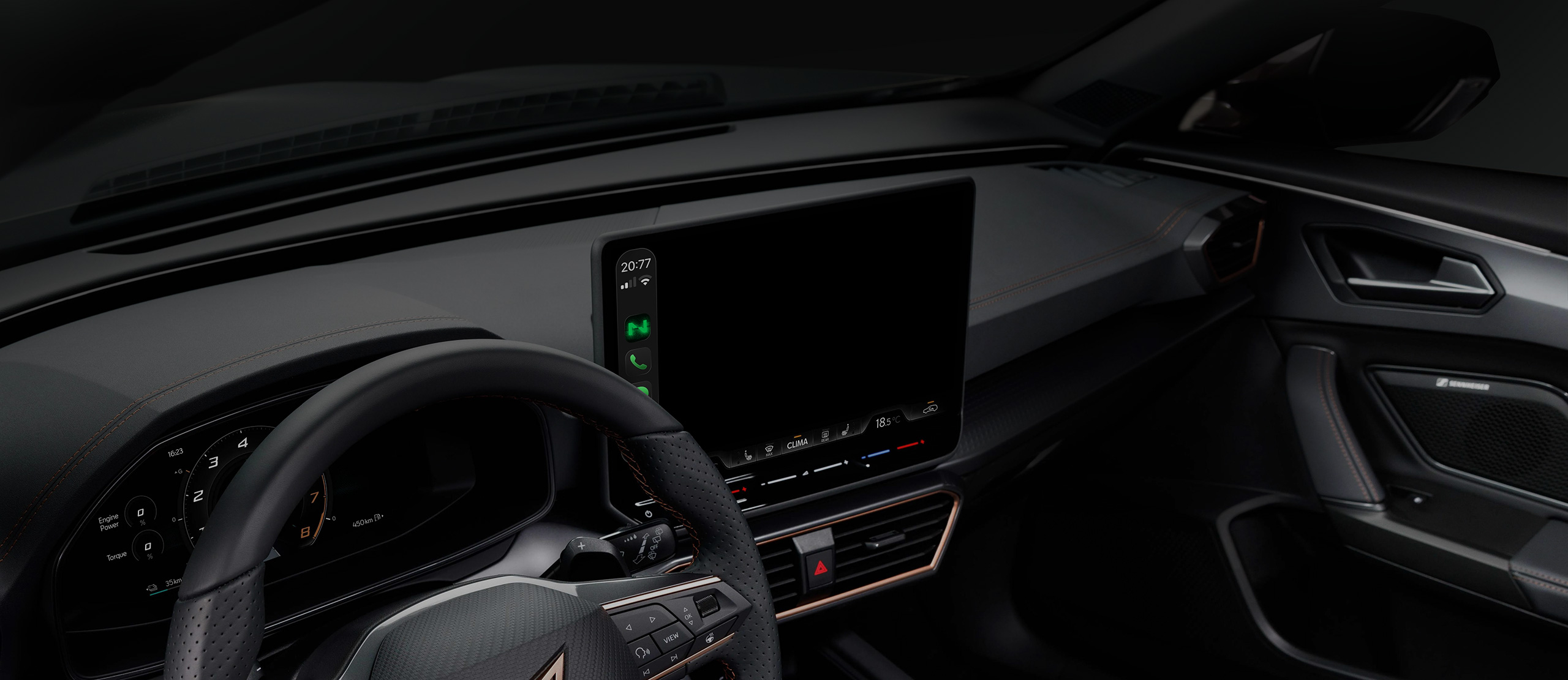
Well, it seems there aren’t that many images. But that’s understandable — the essence here lies more in the absence of images.
CURRENT STATUS
Currently, the application is under development. Since creating an app with such 'extensive' functionality isn't what I would call extremely difficult (especially in the age of AI), I'm developing for both platforms myself — just for fun.
It's also worth mentioning that the main challenge in creating this app is passing the rather strict guidelines that Apple and Google have for applications published for CarPlay and Android Auto. In any case, as soon as the app is available for use in any form, I will definitely write about it here. So, as they say, stay tuned.
CONCLUSION
This case is definitely not the pride of my life, nor the kind of story I’ll tell my grandchildren, but it’s a great example of a niche solution to a small problem. It’s a story about how a small idea can grow into a solution and slightly improve your life. After all, in the end, that’s what we all strive for — to live a little better than we do now, isn’t it?